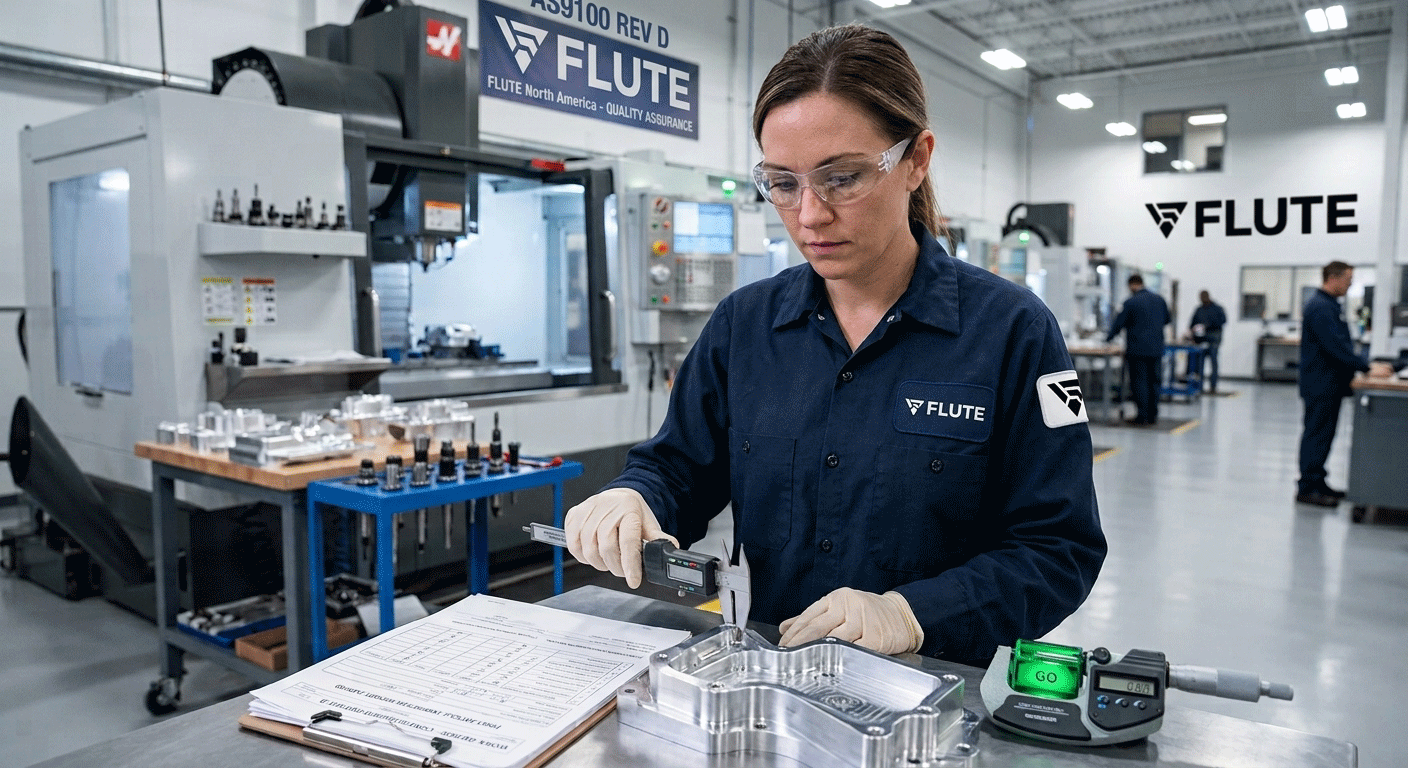
.png)
Precision CNC Machining: The Complete Guide for Aerospace, Defense and Medical Industries

Updated: Jun 7

What Is Precision CNC Machining?
Precision CNC machining is an advanced manufacturing process that uses computer-controlled machine tools to produce highly accurate and repeatable components with extremely tight tolerances.
Unlike traditional machining methods that rely heavily on manual operation, CNC (Computer Numerical Control) machining automates the movement of cutting tools based on digital CAD and CAM data. This enables manufacturers to produce complex parts with exceptional consistency, accuracy, and efficiency.
Today, precision CNC machining plays a critical role in industries where component failure is not an option, including aerospace, defense, medical devices, semiconductor manufacturing, and high-tech industrial applications.
Whether producing a prototype or a full production run, precision CNC machining ensures that every part meets exact engineering specifications.
Why Precision Matters in Modern Manufacturing
In mission-critical industries, even the smallest dimensional variation can affect performance, safety, and reliability.
Precision machining allows manufacturers to:
Achieve tight tolerances and repeatability
Produce complex geometries
Improve product reliability
Reduce assembly issues
Maintain consistent quality across production batches
Meet strict regulatory and customer requirements
As product designs become more sophisticated, precision manufacturing has become a necessity rather than a competitive advantage.
Conventional Machining vs. Precision CNC Machining
While both processes remove material to create finished parts, there are significant differences between conventional machining and precision CNC machining.
Conventional Machining | Precision CNC Machining |
Greater manual intervention | Fully computer-controlled |
Lower repeatability | Exceptional repeatability |
Wider tolerances | Extremely tight tolerances |
Higher risk of operator error | Reduced variability |
Suitable for simple parts | Ideal for complex components |
Slower production scalability | Efficient for prototypes and production |
Precision CNC machining is specifically designed to deliver consistent results for industries that demand accuracy and traceability.
Understanding Critical CNC Machining Tolerances
A machining tolerance defines the acceptable deviation from a specified dimension.
For example:
±0.005" may be acceptable for general industrial components
±0.001" is common in precision manufacturing
±0.0005" or tighter may be required for aerospace and medical applications
Several factors influence achievable tolerances:
Material Properties
Different materials react differently during machining.
Factors include:
Hardness
Thermal expansion
Internal stress
Machinability characteristics
Machine Capability
High-performance CNC equipment provides:
Greater rigidity
Better spindle accuracy
Improved thermal stability
Enhanced repeatability
Tooling and Cutting Parameters
Proper tool selection and machining strategies directly impact dimensional accuracy and surface finish.
Inspection and Quality Control
Precision manufacturers utilize advanced inspection equipment such as:
Coordinate Measuring Machines (CMM)
Optical measurement systems
Surface roughness testers
Digital metrology equipment
Comprehensive inspection processes ensure that parts conform to design requirements before shipment.
Common Materials Used in Precision CNC Machining
Material selection is one of the most important decisions in any manufacturing project.
Aluminum
Popular grades:
6061
7075
Advantages:
Lightweight
Corrosion resistant
Excellent machinability
High strength-to-weight ratio
Common industries:
Aerospace
Defense
Electronics
Stainless Steel
Popular grades:
303
304
316
17-4 PH
Advantages:
Corrosion resistance
Durability
Strength
Sterilization compatibility
Common industries:
Medical
Defense
Industrial equipment
Titanium
Advantages:
Exceptional strength
Lightweight
Corrosion resistant
Biocompatible
Common industries:
Aerospace
Medical implants
Defense systems
Inconel and High-Temperature Alloys
Advantages:
Heat resistance
Oxidation resistance
Mechanical stability in extreme environments
Common industries:
Aerospace engines
Defense applications
Energy systems
Engineering Plastics
Common materials:
PEEK
Delrin
PTFE
Ultem
Advantages:
Lightweight
Chemical resistance
Electrical insulation properties
Common industries:
Medical devices
Semiconductor equipment
Electronics
Aerospace CNC Machining Applications
The aerospace industry demands some of the highest manufacturing standards in the world.
Precision CNC machining is used to manufacture:
Structural components
Aircraft brackets
Housings
Engine components
Hydraulic system parts
Satellite hardware
Key aerospace requirements include:
Tight tolerances
Material traceability
Documentation control
Consistent quality
Repeatable production processes
Because aerospace systems operate under extreme conditions, dimensional accuracy and reliability are critical.
Defense CNC Machining Applications
Defense programs require highly reliable components capable of performing in demanding environments.
Precision CNC machining is commonly used for:
Weapons system components
Communication equipment housings
Vehicle components
Radar system parts
Navigation equipment
Aerospace defense assemblies
Defense manufacturers often require:
Controlled processes
Supply chain security
Documentation traceability
Strict quality assurance protocols
A qualified CNC machining partner must be capable of meeting these rigorous standards.
Medical CNC Machining Applications
Medical devices demand exceptional accuracy, cleanliness, and consistency.
Precision CNC machining supports the production of:
Surgical instruments
Orthopedic components
Medical device housings
Diagnostic equipment parts
Laboratory instruments
Implantable device components
Medical manufacturing requires:
Tight tolerances
Biocompatible materials
Excellent surface finishes
Process consistency
Comprehensive inspection procedures
In many cases, dimensional accuracy directly impacts patient safety and product performance.
Key Benefits of Precision CNC Machining Services
Partnering with an experienced CNC machining provider offers several advantages:
Superior Accuracy
Consistently achieve critical dimensions and engineering specifications.
Faster Time-to-Market
Efficient production processes reduce lead times and accelerate project timelines.
Scalability
Support prototype development, low-volume production, and full-scale manufacturing.
Cost Efficiency
Reduce scrap, rework, and assembly issues through precision manufacturing.
Enhanced Product Quality
Improve reliability, performance, and customer satisfaction.
How to Choose the Right CNC Machining Supplier
Selecting the right manufacturing partner is essential for long-term success.
Consider the following factors:
Industry Experience
Look for a supplier with experience serving aerospace, defense, medical, and other high-precision industries.
Quality Systems
Evaluate their inspection capabilities and quality control processes.
Technical Expertise
Choose a partner capable of reviewing designs and providing manufacturability recommendations.
Material Knowledge
Ensure they have experience machining the materials required for your project.
Production Capacity
Verify their ability to support both current and future production requirements.
Communication and Responsiveness
A reliable supplier should provide clear communication throughout the project lifecycle.
Why Precision CNC Machining Continues to Drive Innovation
As technology advances, manufacturers continue to demand higher accuracy, greater efficiency, and improved product performance.
Precision CNC machining remains one of the most important manufacturing technologies supporting innovation across aerospace, defense, medical, semiconductor, and high-tech industries.
Organizations that invest in high-quality manufacturing partnerships gain a competitive advantage through improved reliability, faster development cycles, and superior product quality.
Request a Quote
Looking for a trusted partner for precision CNC machining services?
FLUTE Manufacturing specializes in high-precision CNC machining for aerospace, defense, medical, semiconductor, and advanced technology industries.
Our team delivers precision machined components with tight tolerances, rigorous quality control, and reliable lead times.
Request a Quote today and discuss your next project with our manufacturing experts.