.png)
AS9100 vs ISO 9001: What Aerospace Buyers Need to Know


"They're ISO 9001 certified, so they should be fine for our aerospace program." It's one of the most common — and costly — assumptions in supplier qualification. ISO 9001 is a solid foundation. It is not the same standard aerospace, defense, and space programs actually require, and treating it as equivalent can put a program's airworthiness documentation, first-article inspection, and traceability requirements at risk.
Here's what actually separates the two standards, and what to verify before you qualify a CNC machining supplier for a flight-critical or mission-critical part.
ISO 9001: The Universal Quality Baseline
ISO 9001 is a general-purpose quality management system standard used across virtually every manufacturing industry. It establishes requirements for:
Documented quality processes and continuous improvement
Management responsibility and internal audits
Customer satisfaction and corrective action
It's a legitimate and valuable certification — but it was written to apply broadly, from furniture manufacturing to electronics to machine shops with no aerospace exposure at all.
AS9100: Built Specifically for Aviation, Space, and Defense
AS9100 is built on top of ISO 9001 — every AS9100-certified organization meets ISO 9001 requirements, but not the reverse. AS9100 adds requirements specific to the risks of aerospace and defense manufacturing:
Configuration Management
Tracking exact part revisions, engineering changes, and configuration control across the life of a program — critical when a single part number can have multiple active revisions in the field.
Risk Management Formalized Into the QMS
AS9100 requires organizations to identify, assess, and mitigate risk at the process level — not just react to defects after they occur.
First Article Inspection (FAI) per AS9102
A formal, documented first-piece verification process confirming that a part matches every dimension and requirement on the engineering drawing before production quantities ship.
Counterfeit Parts Prevention
Explicit controls to prevent counterfeit or unauthorized materials and components from entering the supply chain — a requirement with no equivalent emphasis in standard ISO 9001.
Special Requirements, Critical Items, and Key Characteristics
A structured method for identifying which features of a part are flight-critical or safety-critical and applying tighter control specifically to those characteristics — rather than treating every dimension with equal scrutiny.
On-Time Delivery and Quality Performance Monitoring
More rigorous supplier performance tracking than baseline ISO 9001 requires, reflecting how schedule risk translates directly into program risk in aerospace and defense.
Side-by-Side: Where the Standards Diverge
Requirement Area | ISO 9001 | AS9100 |
General QMS structure | Yes | Yes (built on ISO 9001) |
Configuration management | Not required | Required |
First Article Inspection (AS9102) | Not required | Required |
Counterfeit parts prevention | Not addressed | Explicitly required |
Risk management at process level | General | Formalized and auditable |
Critical/key characteristic control | Not addressed | Required |
Industry scope | Universal | Aviation, space, defense |
Why This Distinction Matters for Procurement
If your program requires flight-critical, mission-critical, or safety-critical components, a supplier holding only ISO 9001 is missing the specific controls your auditors, your customer, and potentially the FAA or DoD will expect to see documented. Discovering this gap after a supplier is already producing your parts is a far more expensive problem than catching it during qualification.
Questions to Ask Before You Qualify a Supplier
Is the AS9100 certificate current and does it cover the specific scope of work you need (machining, not just assembly or distribution)?
Can they produce a compliant First Article Inspection Report per AS9102 for a sample part?
How do they identify and control key characteristics on your specific drawing?
What is their documented process for configuration and revision control when engineering changes occur mid-program?
Do they have a documented counterfeit parts prevention procedure, and can they show material traceability back to certified mill sources?
Who is their certifying body, and is that body itself accredited for AS9100 (not just general ISO certification)?
A Note on ITAR and Export Control
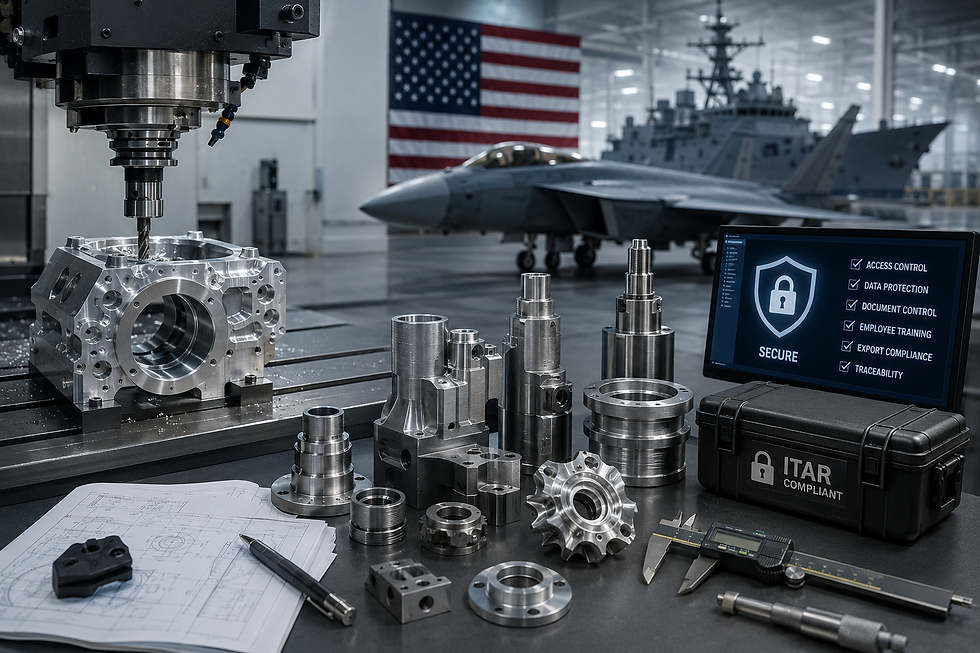
AS9100 governs quality and process discipline. It does not by itself address ITAR export control requirements around who can access defense-related technical data. For programs touching the U.S. Munitions List, a supplier needs AS9100 for quality and documented ITAR compliance for data and access control — they solve different problems and neither substitutes for the other. (For a deeper look at export control specifically, see our ITAR Compliance Checklist for CNC Suppliers.)
How FLUTE North America Approaches This
FLUTE North America operates under an integrated system spanning ISO 9001, AS9100, and ITAR-aligned protocols — not as separate certificates kept in a binder, but as one operating structure governing how parts are quoted, produced, inspected, and documented. For aerospace and defense programs, that means configuration control, First Article Inspection, and critical-characteristic management are built into the process from the first quote, not added on request.
Qualifying a supplier for an aerospace or defense program? Request a technical review with our engineering team and we'll walk through our AS9100 scope, FAI process, and documentation package before you commit a part number.
This article is intended as general guidance for engineering and quality teams evaluating supplier qualification criteria and does not substitute for your organization's formal supplier approval process or your customer's specific flow-down requirements.