.png)
What Is CNC Machining and How Does It Work? A Complete Guide to Precision Manufacturing


What Is CNC Machining?
CNC machining (Computer Numerical Control) is a high-precision manufacturing process that uses computer-controlled machines to produce metal or plastic components with extremely tight tolerances.
Instead of relying on manual operation, CNC machines follow digitally programmed instructions to cut, drill, mill, or turn materials with exceptional accuracy and repeatability.
Today, CNC machining is one of the most widely used manufacturing technologies in industries such as:
Automotive
Aerospace
Electronics
Medical
Energy
Industrial automation
Machinery and equipment manufacturing
Its greatest advantage is the ability to produce complex components with consistent quality and high repeatability.
What Does CNC Mean?
CNC stands for Computer Numerical Control.
This means that machine movements are controlled through software instructions that specify:
Position
Speed
Tool path
Depth of cut
Tool selection
Machining parameters
Thanks to this system, thousands of identical parts can be manufactured with much greater precision than conventional methods.
How Does CNC Machining Work?
The CNC machining process can be divided into several stages.
1. CAD Design
Everything begins with a digital model created using CAD (Computer-Aided Design) software.
Engineers define:
Dimensions
Geometries
Holes
Threads
Radii
Critical surfaces
2. CAM Programming
The design is then imported into CAM (Computer-Aided Manufacturing) software.
Here, toolpaths and machining parameters are established, including:
Cutting speed
Feed rate
Depth of cut
Required tooling
Machining strategies
The result is a G-code program that controls the machine.
3. Machine Setup
The operator prepares:
Raw material
Cutting tools
Workholding devices
Measurement systems
Reference points are also established to ensure dimensional accuracy.
4. Machining Process
The machine automatically executes the programmed operations.
Depending on the application, it may perform:
Milling
Turning
Drilling
Threading
Cutting
Surface finishing
During the process, machine movements are controlled with micron-level precision.
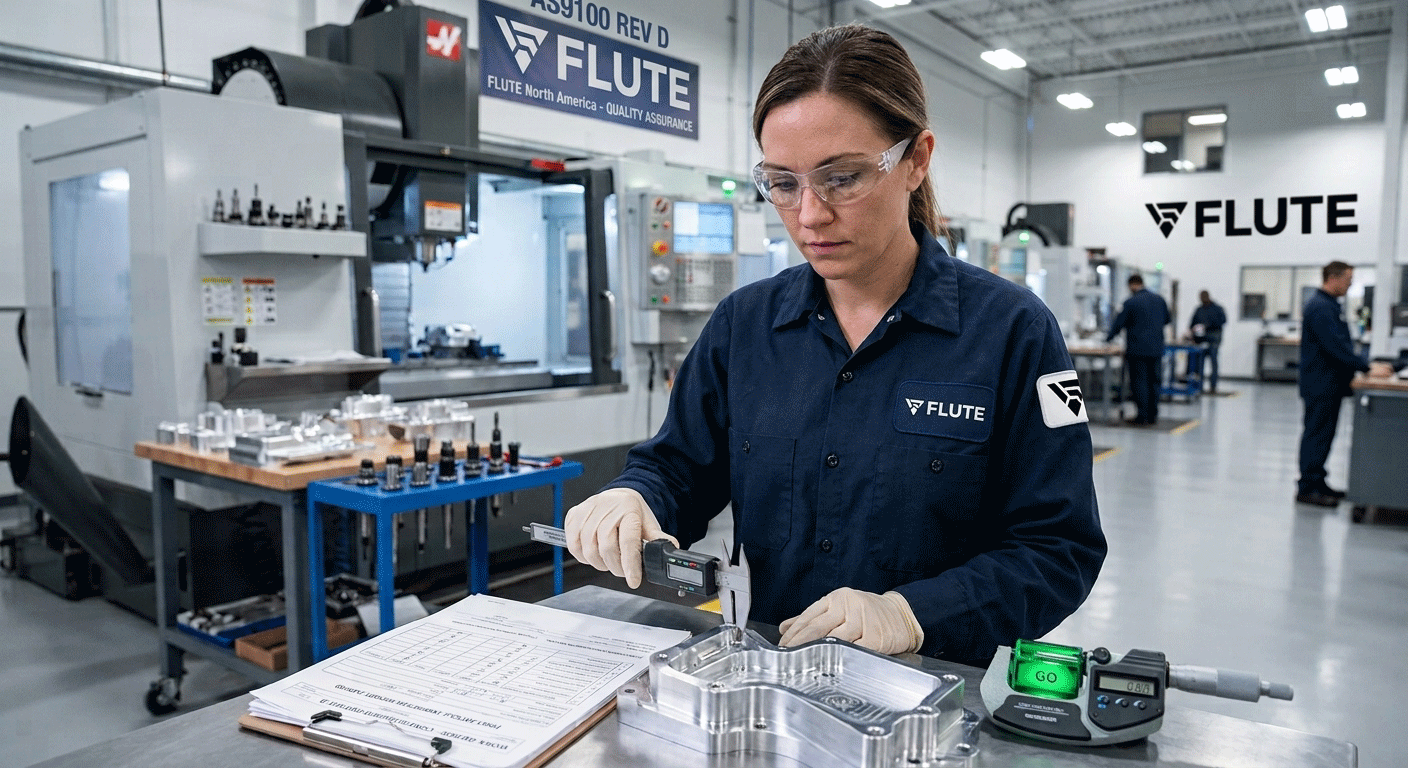
5. Inspection and Quality Control
After machining is completed, the part is inspected for:
Dimensions
Tolerances
Surface finishes
Critical geometries
Common inspection tools include:
Calipers
Micrometers
Dial indicators
Coordinate Measuring Machines (CMM)
Types of CNC Machines
Different CNC technologies are used depending on the application.
CNC Machining Centers
These are among the most common machines in modern manufacturing.
They can perform:
Milling
Drilling
Tapping
Complex contouring
Machining centers are available in:
3-axis
4-axis
5-axis configurations
CNC Lathes
Designed for cylindrical or rotational parts, CNC lathes are widely used to manufacture:
Shafts
Bushings
Connectors
Automotive components
CNC Milling Machines
These machines are ideal for producing prismatic parts and complex geometries.
They can machine materials such as:
Aluminum
Steel
Titanium
Stainless steel
Engineering plastics
5-Axis CNC Machines
5-axis machines allow complex surfaces to be machined in a single setup.
They are commonly used in industries such as:
Aerospace
Medical
Defense
Energy
What Materials Can Be Machined?
One of the greatest advantages of CNC machining is its versatility.
Metals
Aluminum
Carbon steel
Stainless steel
Titanium
Copper
Brass
Inconel
Engineering Plastics
Delrin (Acetal)
Nylon
UHMW
PTFE (Teflon)
PEEK
PVC
ABS
Benefits of CNC Machining
High Precision
Tolerances can reach ±0.001 inches or even tighter depending on the application.
Repeatability
Thousands of identical parts can be produced while maintaining consistent quality.
Increased Productivity
Automation reduces production times and minimizes human error.
Complex Geometries
CNC machining enables the production of components that are difficult or impossible to manufacture using conventional methods.
Reduced Material Waste
Optimized toolpaths maximize raw material utilization.
Scalability
The same program can be used for prototypes, low-volume production, or large-scale manufacturing.
CNC Machining Applications Across Industries
Automotive Industry
CNC machining is used to manufacture:
Engine components
Housings
Brackets
Shafts
Transmission components
Precision and repeatability are critical for maintaining automotive quality standards.
Aerospace Industry
CNC machining produces critical components for:
Aircraft
UAVs and drones
Propulsion systems
Defense equipment
These applications demand extremely tight tolerances and rigorous quality standards.
Medical Industry
CNC machining is used to manufacture:
Surgical instruments
Implants
Components for medical devices
Industrial Automation
Manufacturers rely on CNC machining to produce:
Fixtures
Jigs
Molds
Machine components
Robotic systems
Conventional Machining vs. CNC Machining
Feature | Conventional Machining | CNC Machining |
Operation | Manual | Automated |
Precision | Moderate | High |
Repeatability | Limited | Excellent |
Productivity | Moderate | High |
Complex Geometries | Difficult | Easily achievable |
Human Error | Higher | Lower |
Mass Production | Limited | Ideal |
Why Is CNC Machining Essential in Modern Manufacturing?
Today's industries require:
Higher quality
Faster lead times
Competitive costs
Repeatability
Traceability
Production flexibility
CNC machining addresses these needs through automated processes capable of producing highly accurate and consistent components, making it one of the foundations of modern manufacturing.
Conclusion
If you are wondering what CNC machining is or how CNC works, the answer is straightforward: it is an advanced manufacturing technology that uses computers and automated machines to produce high-precision components with exceptional repeatability and efficiency.
Because of its ability to machine a wide range of materials and create complex geometries, CNC machining has become indispensable in industries such as automotive, aerospace, medical, and industrial automation.